
Build a Greenwood County Deed Chain Backward
A former-owner chain records real transfers, not just names lifted from a parcel card. Start with the newest deed. Then work backward, turning each grantor into the next grantee you hunt for. Log every step in a consistent format. That habit makes gaps jump out fast. A broken Greenwood County deed chain tells you exactly where to look next.
| Transfer Date | Grantor to Grantee | Deed Type | Book/Page or Document |
|---|---|---|---|
| Newest recorded date | Prior owner to current grantee | As indexed | Copy from the Register result |
| Next earlier date | Earlier grantor to prior owner | As indexed | Carry book/page exactly |
| Earlier book entry | Repeat with the same tract | As recorded | Use courthouse index and book |
Never fill a row from memory or from an atlas label. The indexed instrument at the Register of Deeds gives you the names and the deed type. It also supplies the reference you can cite. A historical plat map can point you toward a likely transfer. It cannot replace the deed record itself. The official Register page details the Greenwood County index depth and workstation access.
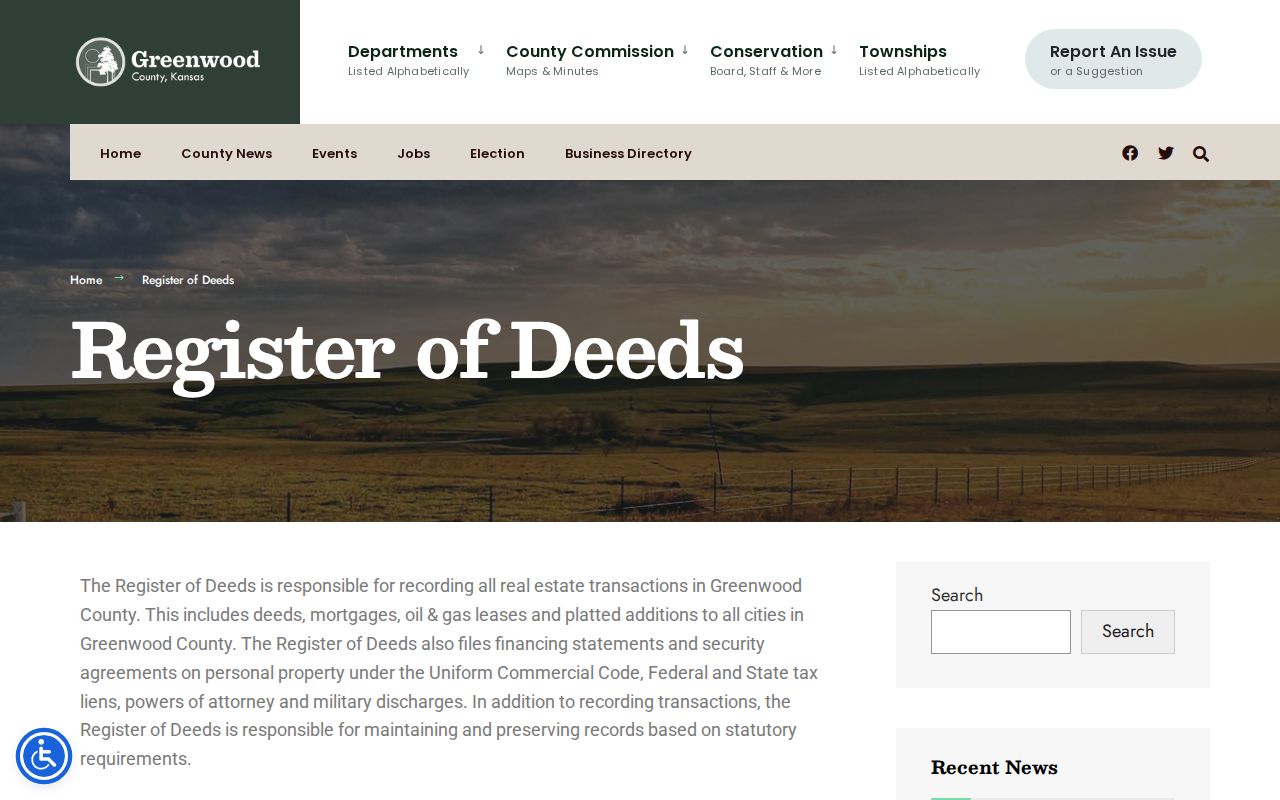
The Register's site covers how to reach the deed index. Every former-owner link must still come from the indexed deed itself.
Start Greenwood County Former-Owner Work With the Land
Open ORKA and copy the Parcel ID, Location, and Boundary Description. A city tract may be described by addition, block, and lot. Rural ground usually relies on Section, Township, and Range. The legal description outlasts any street address. It also helps you prove two separate deeds concern the same land. That match is the whole point of the chain. Greenwood County examples offer useful starting points. These include Eureka Original City, Bells Addition in Severy, and the Sarah Fochts and Brumbaughs subdivisions in Madison. Search those terms exactly as written. Skip trying to decode the long parcel ID digit by digit. The county publishes no legend explaining each segment. The written description is the safer key.
Switch Greenwood County Grantor and Grantee Roles
Every Greenwood County ownership chain starts with the Register of Deeds, the office that records each legal transfer. Begin with today's grantee and step back one deed at a time, treating each grantor as the next person whose acquiring deed you must locate in the property records.
- Find the current owner's deed with that owner as grantee.
- Read the grantor and verify the conveyed legal description.
- Search that former owner as grantee on an earlier deed.
- Repeat, preserving dates, deed types, and book/page or document references.
- Grantor
- The party conveying an interest.
- Grantee
- The party receiving that interest.
- Chain of title
- The ordered transfer sequence for the same land.
- Reverse index
- An index organized to help locate parties on the other side of a deed.
- Quitclaim versus warranty
- A quitclaim conveys the grantor's interest without the promises typical of a warranty deed.
Greenwood County's Numerical Index Begins in 1858
Greenwood County's numerical indexes reach back to 1858. That start date is remarkably early. It reaches nearly to the county's founding, and it gives former-owner research rare depth. The courthouse is open for public deed research on weekdays from 8 a.m. to 5 p.m. It closes on holidays. When you arrive, ask staff for the specific grantor and grantee books you need. Avoid requesting every old deed at once.
Time-depth limit. The numerical index reaches 1858, but public workstations are described for 2003 forward. Earlier owners require the courthouse indexes and deed books, not an assumption that every image is online.
Do Not Mistake 2003 for Greenwood County's First Deed
Three public workstations at the courthouse reach property records from 2003 forward. That year is an access breakpoint, nothing more. It does not mean the deed series starts in 2003. Nor does it mean older images are missing. The county publishes no exact online image cutoff for its deed records. Does your prior-owner chain cross that line? Bring the same names and legal description to the counter. Earlier owners still appear in the numerical index and the deed books. Ask staff for those sources plus any prior-instrument references. Help is also available by phone at 620-583-8162 or by email at deeds@greenwoodcounty.org.
Bridge Greenwood County Trust, Estate, and TOD Transfers
Not every Greenwood County parcel changes hands through a plain warranty deed. A 2026 local digest shows a transfer-on-death deed for Carters Whitehall Bay Subdivision. It sits alongside a quitclaim into a revocable trust. Probate complicates things further. Executor deeds, administrator deeds, affidavits, and later trust conveyances can all break a tidy buyer-seller sequence. The break shows up in the property records. Search by instrument name and check both party roles. When probate explains the handoff, pull the 13th Judicial District case record for context. Then return to the recorded deed for the actual land transfer. A restricted death certificate is used only by an eligible requester. It is pulled only when it is truly needed.
Use Greenwood County's 1922 Atlas as a Snapshot
The Kansas Memory atlas runs 78 pages across three sections. Township landowner maps sit beside town plats and a patrons directory. Portraits and images of homes and farms fill the rest. That mix lets you place an earlier owner of record in a particular township. It can also pin that owner to a platted town at a single point in time.
Work backward from the current ORKA Boundary Desc. Match it to the right city or township plate. Then compare the historic owner or lot label against today's parcel. The deed records between those two moments still need verifying. Treat the atlas as a map to where the deed search should go. It is not a current title chain, and it is not a boundary survey.
Search Madison and Severy Former Owners Under Old Place Names
Old place names can bury former owners. Madison's early settlements and its railroad move left behind Madison #1 and #2 references that predate the present street grid. Severy began as the Gould post office. So a directory or newspaper entry may carry one of those older labels even though the parcel you want sits inside modern Madison or Severy boundaries.
Run your search under both names. Then anchor any match to the subdivision, the lot and block, or the PLSS description, because a city's post office, town plat, incorporation, and current boundary each mark a separate layer of its history. A shared surname in the right town proves nothing by itself.
Treat Greenwood County Deed Notices as Leads
Greenwood County deed notices make strong leads. The Eureka Herald's 2026 court-news digest lists document numbers and instrument types. It also names parties and exact subdivision or PLSS descriptions. Those details can steer a former-owner search toward the correct recorded instrument. The digest also surfaces trusts, TOD deeds, and mineral cases. A broad property records query might miss them.
Remember what it is not. It is a transcription. It is not the full Register of Deeds index, and not a certified copy. Confirm every transfer with the Register before relying on it. For older gaps, layer in KSHS newspaper holdings and FamilySearch's 1871-1925 district-court dockets. A focused Kansas Open Records Act request naming the specific record you need can fill the rest.
Extend Greenwood County Previous Owners Beyond the Deed Screen
Offline access is not the same as lost history. KSHS keeps county histories, newspaper microfilm, directories, census material, naturalization files, corporation records, and place indexes. Its Greenwood County Scenes collection spans 1910 through 1960 and covers Eureka, Madison, Virgil, Piedmont, and oil-field views. Photographs can help date a place. Still, they cannot name a legal owner without a deed or tax source behind them.
A rarer path runs through the J.B. Watkins papers at KU Spencer Research Library. Among them sits a 1902 Greenwood County land-company deed folder, filed as RH MS 1, Box 192, Folder 36. Treat it as a focused special-collections lead rather than a countywide index. Before asking the archive for help, bring a name, a date, a tract, or a company.
Directories list residents, business addresses, and an own-home mark. Read those as occupancy clues only. Check each entry against the legal description, the deed, the tax record, a probate file, or a plat before you add anyone to the chain of former owners.
Follow Greenwood County Mineral Owners on a Separate Chain
Surface ownership does not always carry every mineral interest. Greenwood's Register records oil and gas leases, assignments, releases, and reservations. KSHS images show a 1929 gusher north of Thrall and 1937 oil workers at Sallyards. Those images show why that record stream matters here.
Run the same Section-Township-Range description against lessors, lessees, and prior parties. A 2026 court digest described a declaratory judgment. It concerned mineral interests in Section 16, Township 23 South, Range 13 East. The surface parcel card alone cannot name every former mineral owner.
Know Where Greenwood County's Former-Owner Trail Stops
Mineral interests can sit on a chain of their own. Greenwood's Register of Deeds records oil and gas leases, assignments, releases, and reservations. These sit separately from surface title. KSHS photos show a 1929 gusher north of Thrall and 1937 crews at Sallyards. They show why that stream matters in this county.
Run the same Section-Township-Range description under lessors, lessees, and prior parties. A 2026 court digest described a declaratory judgment. It covered mineral interests in Section 16, Township 23 South, Range 13 East. The surface parcel card alone will not name every former mineral owner in Greenwood County.
Lawful use. Former-owner research supports title work, estate matters, and house history. Never use names or addresses to track, threaten, or harass a living person.