
Distinguish Deed Types in Greenwood County Records
In Greenwood County, the Register of Deeds is the office that records instruments affecting real property. The instrument type tells you what kind of transfer to expect. Still, the full text of the document controls. Recent recorded notices include warranty deeds, quitclaim deeds, and transfer-on-death deeds, along with conveyances to trusts and legal descriptions drawn from both named subdivisions and the Public Land Survey System.
| Deed Type | What It Does | Common Use |
|---|---|---|
| Warranty deed | Conveys the stated interest with deed covenants | An ordinary sale |
| Quitclaim deed | Conveys whatever interest the grantor holds | Trust, family, or title cleanup |
| Transfer-on-death deed | Names a beneficiary for a death transfer | Estate planning |
| Executor or administrator deed | Conveys through an estate representative | Probate property |
| Plat or dedication | Creates or depicts lots, blocks, streets, or easements | Subdivision history |
Not everything in the deed index transfers land. Mortgages, liens, oil and gas leases, and releases sit beside the deeds without moving the surface estate. Read the document type and the legal description before adding any entry to an ownership chain.
Reach Greenwood County Deed Records from 1858 Forward
The Register's numerical indexes reach back to 1858 and continue to the present. Older deed books live at the courthouse. Three public workstations there cover records from 2003 forward. For remote access, ORKA offers a free property and deed search. The county publishes no single cutoff for online deed images, so an empty web result never proves an instrument went unrecorded. The Register of Deeds page identifies the courthouse access points that connect the workstation era to the older numerical index.
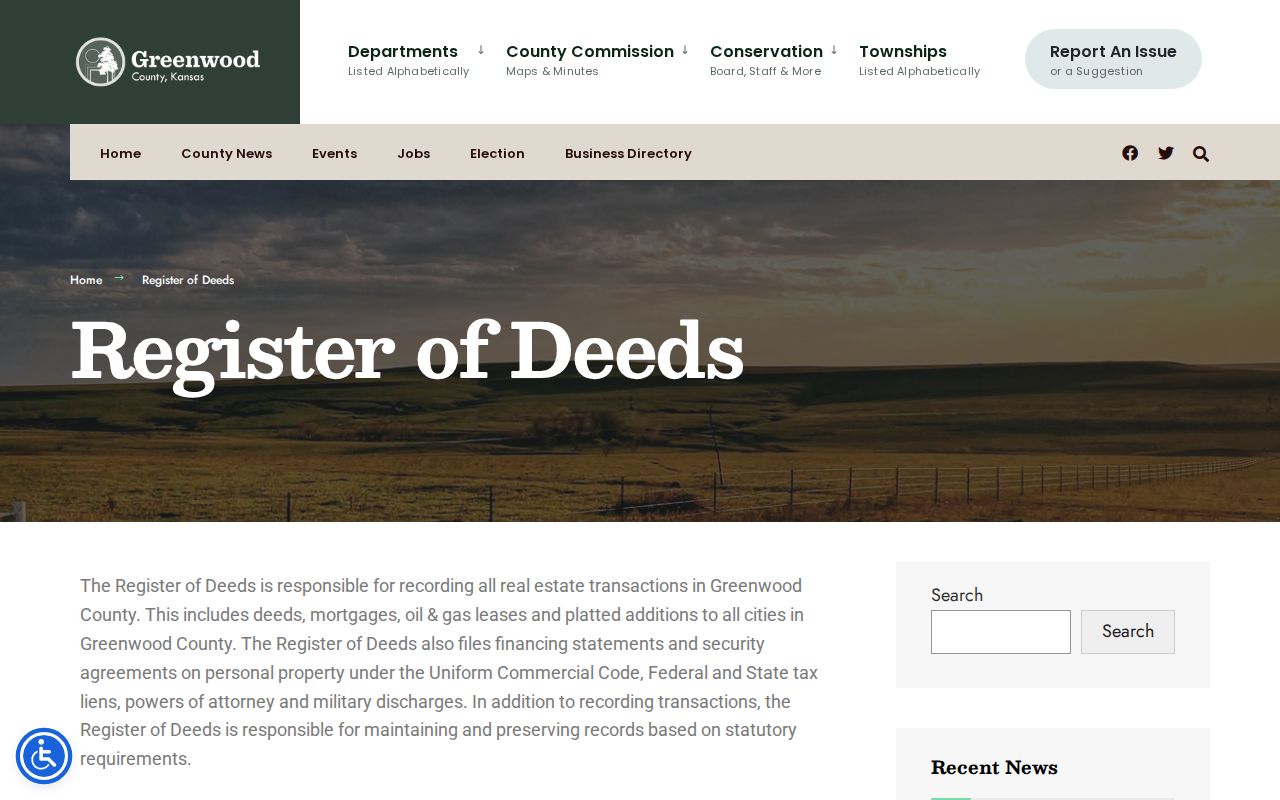
Check the Greenwood County recorder's official page before visiting, since deed records access and payment details can change.
Search Greenwood County Deeds with Exact Party Clues
The county deed search offers plenty of handles: document type, book, page, document number, grantor, grantee, date range, legal description, subdivision, block, lot, section, township, and range. Start broad. A surname or entity name works well at first. Then narrow by date or land description. For an LLC or trust, search the recorded name exactly. Try punctuation variants when the first pass misses.
| Field group | Useful entries | Why it helps |
|---|---|---|
| Party | Grantor, grantee | Find who gave and received the interest |
| Instrument | Type, document number, book/page | Retrieve one filing |
| Time | Recording date range | Separate repeated names |
| Land | Subdivision, lot, block, section, township, range | Hold the chain to one tract |
Walk the Greenwood County Grantor-Grantee Index
Every chain starts with one anchor deed tied to the present parcel. The grantor gives and the grantee receives. Find the current acquisition deed first. Then reverse that grantor's role to locate the earlier deed by which they took title, and repeat the process while holding the legal description constant.
- Find the present owner's acquisition instrument with that owner as grantee.
- Read the grantor, recording reference, deed type, and full legal description.
- Search the grantor as an earlier grantee and verify the same tract.
- Continue at the courthouse numerical index and deed books when the workstation trail ends.
- Grantor
- The party giving the stated interest.
- Grantee
- The party receiving it.
- Chain of title
- The linked sequence of instruments for the same land.
- Book/page or document number
- The retrieval reference assigned to a recorded filing.
Read a Greenwood County Deed Notice as a Lead
A June 2026 Eureka Herald transcription shows the county's record vocabulary at work. Each entry lists a document number, instrument type, grantors, grantees, and legal description. One item, number 2026-0591, is a transfer-on-death deed for Lot 6, Block A, Carters Whitehall Bay Subdivision. Another is a warranty deed covering Sections 7 and 8, Township 23 South, Range 13 East. The published court and deed digest displays the full set of entries.
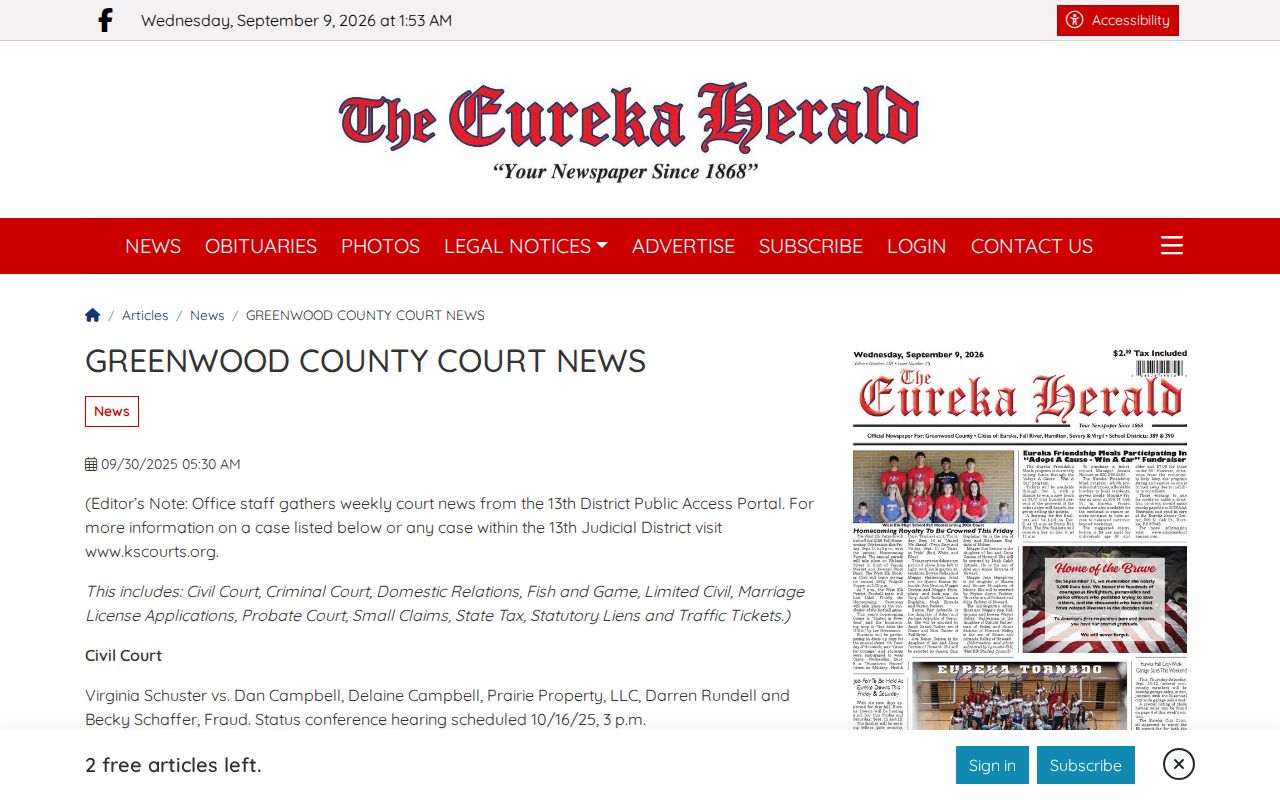
The newspaper works well as a bridge. It can surface a name or document number, but the Register's own record remains the source for the complete deed.
Trace Greenwood County Trusts, Estates, and Minerals
A tidy run of warranty deeds is not the only chain you will meet in Greenwood County property records. Trusts appear often. A quitclaim may move an interest into a revocable trust, or a transfer-on-death instrument may precede a beneficiary's later filing. Executor deeds, administrator deeds, affidavits, and probate orders connect a death to the next owner of record. Minerals need separate care. County records include oil and gas leases keyed to section-township-range descriptions, and a 2026 civil case involved unknown mineral claimants in Section 16, Township 23 South, Range 13 East. A surface parcel card alone never settles mineral ownership.
Connect Greenwood Plats to Historic Deed Books
Plats create streets and lots. City additions, blocks, roads, and easements can all originate in a recorded plat, so when a modern deed names Eureka Original City or another addition, treat that wording as a durable search key. The 1922 Geo. A. Ogle atlas adds township landowner maps and town plats for historical context. The Register's instruments still control the legal trail. History also reaches beyond the courthouse. A KU special collection holds 1902 Greenwood County land-company deeds within the J.B. Watkins papers. Such a collection can explain a development story hidden from a current parcel card. Reconcile anything it shows against the county index.
Request a Greenwood County Deed Copy
Preparation makes a copy request painless. Use ORKA or the index to gather the party name, document number or book and page, date, and legal description before contacting the Register. Copies come through the courthouse route. The county names KanPay for copy payments, with a 2.5 percent service charge, and Simplifile for electronic recording. Fees and certification levels vary by instrument. Ask the office what applies rather than assuming an image is certified.
Recorded does not mean guaranteed. Greenwood County deed records show filed instruments, not a title opinion, and an index entry cannot disclose every unrecorded claim.
Bridge Older Greenwood County Deeds to Modern Parcels
A century-old deed index rarely lists a street address or a modern parcel number. Work from the grantee instead. Pull the book or numerical-index reference. Copy the legal description word for word. Then match its lot, block, addition, section, township, and range against ORKA. The land stays constant even when surnames and mailing addresses shift over decades.
Supporting collections add context, though none replaces the county record. Kansas Memory holds a 1922 atlas of 78 pages in three sections. It includes township landowner maps, town plats, farms, portraits, and a patrons directory. The Kansas Historical Society keeps county histories, newspapers, directories, and place indexes. FamilySearch catalogs Greenwood district-court appearance dockets from 1871 through 1925. The originals are held at the Eureka clerk's office.
Treat an atlas label as a clue, never a conveyance. Let it surface a spelling, a location, or a neighboring owner. Then return to the Register of Deeds books for proof. A newspaper notice works the same way. It may reveal parties and a document number, but only the filed instrument carries the controlling text.
Check Greenwood County Deeds for More Than the Owner Name
A deed indexed to the right parties can still convey only part of a tract. It can also convey a limited interest. Read the granting clause first. Then work through the named capacities and any consideration language. Cover the legal description, reservations, exceptions, easements, signatures, acknowledgments, and the recording stamp. Mineral reservations deserve extra care in Greenwood County. Oil and gas history and section-based instruments there can run separately from the surface parcel.
Plats and prior instruments may be incorporated by reference. Note every cited book, page, or document number. Retrieve each one as another link in the chain. Match a release to the mortgage or lien it addresses. Read a corrective deed beside the instrument it fixes.
Recording a document is not the same as resolving its meaning. Register staff provide access and copies. They do not settle competing claims or certify a clear chain. A purchase, boundary dispute, mineral claim, or other legal reliance calls for outside help. A Kansas attorney or title professional is the right source for a title conclusion.
Keep a plain copy for research. Request certification only when an agency or proceeding requires it. Note the certification date, fee receipt, and instrument reference so the copy's origin stays traceable.
Use Greenwood County Deed References Without Losing the Tract
A document number or book-and-page citation fetches an instrument. It cannot confirm that every acre described matches the parcel in question. Compare the subdivision, block, lot, section, township, and range against the ORKA boundary description. A deed conveying several tracts deserves a separate note for each. A mineral reservation or easement grant should be recorded apart from the surface transfer.
Names demand the same discipline. Search prior surnames and initials alike. Try joint owners, trustees, and the full legal name of any entity. An ORKA owner field may abbreviate. The deed itself states capacities such as trustee, executor, or member. One local sample shows a quitclaim moving land into a revocable trust. That proves an entity search cannot stop at the individual name.
For historical work, date-stamp every index observation. Greenwood County's courthouse trail reaches far beyond the workstation era. A later re-recording, corrective deed, affidavit, or release can reshape an earlier entry's meaning. Cite each step in writing rather than rebuilding the chain from memory.